
Search for positions – Here - Online Opportunities
New action center for the green jobs movement
Green For All released a new interactive, multimedia website that includes information on the organization’s programs, focus areas, and key policy initiatives as well as numerous resources detailing the green jobs movement and how to get involved. Check out Green For All’s blog and videos, featuring community partners as well as hip hop artists.
“Green For All’s new website will serve as an action center for the green jobs movement and will leverage capacity and movement building around these core issues that are integral to the health and well-being of our community and environment,” said Phaedra Ellis-Lamkins, CEO of Green For All.
Local students gain experience in innovation at Summer Science Institute
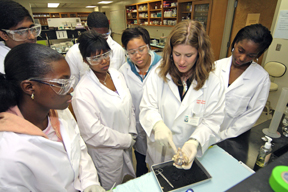 Local African-American middle school students will attend a Summer Science Institute to experience innovation firsthand June 18-22 at Texas Instruments in Santa Clara.
TI is partnering with the Greene Scholars Program to offer the annual, hands-on learning event to create excitement about science, technology, engineering and mathematics (STEM) among these 30 high-achieving, 11-to 14-year old African-American scholars.
Throughout the week the students will work directly with a team of TI engineers who volunteered their time and ideas for activities that explore innovation, product development, solar technology and sports science. In this collaborative team environment, these young scholars will conceptualize and develop their own innovative projects, and, at week’s end, present a product idea based on what they learned. Hands-on activities including building towers using marshmallows and toothpicks, designing futuristic bike helmets, and building and racing solar cars will demonstrate concepts learned about innovation and product development. In addition to the interactive workshops, the students will participate in a “sports science challenge” at the company’s fitness center and tour TI Silicon Valley Labs, as well as interact over lunch with the TI volunteers. Full article: Local students gain experience in innovation at Summer Science Institute
New York City Creates New Green Jobs
 Mayor Michael R. Bloomberg, Governor Andrew M. Cuomo, Brooklyn Borough President Marty Markowitz and State and City elected officials today announced that the Brooklyn Navy Yard Development Corporation will invest $46 million to build a Green Manufacturing Center in the Navy Yard. This New York City Regional Economic Development Council priority project consists of the adaptive reuse of three former WWII-era Navy machine shops into a state-of-the-art industrial complex, creating nearly 300 new permanent jobs and approximately 400 construction jobs.
“The Brooklyn Navy Yard is an economic success story if there ever was one, and this investment in green manufacturing is more great news for the Navy Yard and for New York City’s economy,” said Mayor Michael R. Bloomberg. “Today the Navy Yard is home to the kind of innovation that is going to create the jobs of the future and keep our city competitive in the long-term.”
“This project is an example of how the Regional Council initiative is helping the state invest in a productive and sustainable innovation economy that will put New Yorkers back to work now and for years to come,” Governor Cuomo said. “This is an eco-friendly investment that will create almost 300 new jobs while making space available for a successful company to produce the tools needed to keep the heroic members of our armed services safe. Read the article: New York Creates New Green Manufacturing Jobs
”The Truth About Green Jobs: A Case Study
Over the last year, green jobs have become a political punching bag. But in many states throughout the country the industry is gaining traction. In Massachusetts, more than 64,000 engineers, construction workers and entrepreneurs have found jobs in the sector. The Center for American Progress came here to learn how they’re doing it, and to tell the real story about the clean energy economy.
Hoffa: America’s Recovery Depends On Good, Green Jobs
 Teamsters General President Jim Hoffa issued the following statement as part of the union’s observance of Earth Day. “As we prepare to celebrate Earth Day this year, I am reminded of how far our union has come over the last decade since first forging our alliance with our partners in the environmental movement.”It was in 2001 that our two groups first joined together during the ‘Battle for Seattle’ to demonstrate against the WTO. The Teamsters and environmentalists understood that members of a society cannot survive when you allow the deregulation of trade and the destruction of the environment. That path would only lead to the exploitation of both the environment and workers.
“While the blue-green movement was born in Seattle, we have continued to stand with our brothers and sisters in the environmental movement. Together we have fought to create a sustainable supply chain that not only provides good-paying jobs with benefits but ensures that companies safeguard the environment and the health and safety of our communities.”For example, in Los Angeles, the Teamsters and our environmental allies like the Sierra Club and the Natural Resources Defense Council along with the Los Angeles Alliance for a New Economy have been fighting to raise standards for drivers in the port and for workers in the solid waste and recycling industry. Through the Clean Truck Program and the Don’t Waste L.A. campaigns, we are well on our way to making a real difference for workers who have been exploited by these industries for too long.
“The Teamsters, along with the support of Los Angeles Mayor Antonio Villaraigosa, have reduced the deadly diesel pollution in the port through the Clean Trucks Program. And in a historic vote, port drivers employed by Australian company Toll voted to join the Teamsters. Their brave stand in the face of a vicious anti-union campaign will pave the way for their brothers and sisters across the country to join them in seeking justice on the job and fundamentally change the way the port industry treats their drivers.”If we can build upon these victories and continue to turn green jobs into good jobs, we can improve the lives of thousands of working families across the country and help them achieve the American dream.”
TheLadders Earth Day Survey Shows Eco-Conscious Companies Are Growing on Job Seekers
 In celebration of Earth Day on April 22nd, TheLadders released a new survey today revealing that job seekers go for the green when making a decision about their future employer. In fact, when offered two equal job opportunities, 72% of candidates would choose the more eco-conscious company versus 10% who said that they would not. Less than a fifth (18%) said it would not influence their decision. TheLadders, the most comprehensive job-matching service for career-driven professionals, surveyed more than 100 professionals in the following industries: construction, education, engineering, finance, human resources, law, marketing, medical/science, operations, real estate, sales and technology. Read the full article: - TheLadders Earth Day Survey Shows Eco-Conscious Companies Are Growing on Job Seekers -
Report shows clean energy sector growing across country, industries
Clean energy employers announced plans involving at least 137 projects in 42 states during the first quarter of this year, according to an analysis released today by Environmental Entrepreneurs (E2). Read the full article: Report- Q1 Clean Energy Announcements Could Lead To 46,000 Jobs In 42 States
Larry Schweiger, National Wildlife Federation
Larry Schweiger, President and CEO of the National Wildlife Federation, speaks to attendees at the 2012 Good Jobs, Green Jobs South conference.
Green Jobs: Siemens is Hiring College-Level Students
 Siemens is hiring over 400 college-level students to join its Summer Intern Program across the Energy, Infrastructure and Cities, Industry and Healthcare sectors. At the end of each summer, Siemens recruits top performing interns from its program to become full-time employees.
The Siemens Summer Intern Program lasts three months and offers college-level students the opportunity to learn about Siemens businesses first-hand and cultivate essential career development tools through mentorship and networking opportunities.
“Siemens is committed to developing talent, both for our existing employees and by identifying and nurturing new entry level talent. We offer multiple internship programs across our businesses with a goal of converting the best candidates to full-time employees once they graduate,” said Mike Panigel, Chief Human Resources Officer for Siemens in the Americas. “Through this program we have an opportunity to get to know the candidates and they get to know Siemens – it enables all of us to make informed hiring decisions. The fresh ideas and enthusiasm of these new recruits are critical to the sustainability of the organization.”
Internship positions primarily focus on the following areas: Engineering, Finance, IT, Marketing, Operations, Procurements and Sales. Siemens is specifically looking for students with education or experience in science, technology, engineering and math (STEM) to match well with its portfolio of high-tech products and solutions, including green building design, renewable energy, healthcare and mobility.
Each year, Siemens holds recruiting events at college and university campuses across the country. Interested students are encouraged to find more information on internship programs and apply online.
Green Jobs Growing in Los Angeles
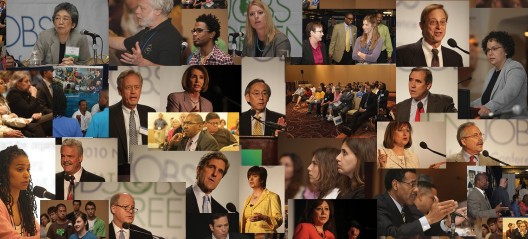 Carol McClelland, founder of Green Career Central will be one of the participants of the Good Jobs, Green Jobs West conference on Thursday, March 15th and Friday, March 16. You can take a look at Good Jobs, Green Jobs Over the Years: Video and Images from Past Conferences
and get a sense of how transit systems and high-speed rail in California creating are good jobs and a cleaner environment? How are state-level policies ensuring that clean energy technologies are being manufactured here in the United States? At Good Jobs, Green Jobs West — March 15 and 16 in Los Angeles, CA at the Westin Bonaventure Hotel & Suites — you can explore the unique challenges and opportunities to creating good, green jobs in the Western United States.
In the last four years, the Good Jobs, Green Jobs National Conference has emerged as the nation’s leading forum for sharing ideas and stragizing on building a cleaner, greener and more prosperous American economy. This year, the Good Jobs, Green Jobs Conference will be held in four regions across the United States–presenting a unique opportunity in each of these regions to ignite the development of a green economy that creates good jobs and preserves America’s economic and environmental security.
Every year, thousands of business and community leaders, elected officials and opinion makers, union members and environmentalists come from across the country for this exciting event. Past Conferences have included plenary speakers like EPA Administrator Lisa P. Jackson, Energy Secretary Dr. Steven Chu, House Speaker Nancy Pelosi, Senator John Kerry, and corporate leaders from across the spectrum of international economy.
Where the Jobs Are: Higher Technology Manufacturing
 The following is a statement by Eric Spiegel, President and CEO of Siemens Corporation and CEO of the U.S. Region.
Last month President Obama invited business leaders to the White House to discuss strategies for reversing the terrible tide of outsourcing that has battered American manufacturing for more than a decade. I was honored to be one of them.
I told the president that I believed the conventional wisdom about manufacturing’s inevitable decline was wrong. For too long, we’ve operated under the assumption that because labor is cheaper elsewhere, and because no company, however well-intended, would choose to build something for more when they could build it for less, manufacturing here was more or less doomed.
But that conclusion assumed a couple of things that have turned out to be wrong: First, that cheaper wage rates would always translate to lower production costs. And second, that the products of the future, like those of the past, would essentially be commodities, the kind that could be built of equal quality, with equal technology, anywhere in the world. Read the full article:New York Creates New Green Manufacturing Jobs
Green Icon lays out facts of the green economy
 Written by: Phaedra Ellis-Lamkins – Chief Executive Officer of Green For All
Since 2008, these two things haven’t changed: the world is getting warmer and millions of Americans are out of work. They’re not going away any time soon.
Green For All was founded on the idea that those two problems could be relieved with a common solution, green jobs. We’ve seen that this can work; renewable energy businesses are among the fastest growing in the American economy.
We’ve also learned that the green economy holds much more promise than just renewables. The scope of jobs that improve our environment runs from factory workers building high-efficiency vehicles to entrepreneurs selling organic skincare products to businesses that turn a profit recycling waste from shredded automobiles.
In July, the Brookings Institution released a report detailing the extent of the green economy. Some 2.7 million Americans work at green jobs – more than work in the fossil fuel industry. The US Conference of Mayors estimates that number will almost triple by 2040. And green jobs are quality jobs. Median wages are 13 percent higher than the median – and they’re available to more Americans who have a high school degree. Investment in clean energy projects yields more than three times as many jobs as investing in fossil fuels.
Even so, there is a lot of room for growth. Back in 2008, we argued that the green economy held great promise – and could grow to scale if Congress acted boldly. Had Congress passed comprehensive climate legislation, for example, or if they’d enacted the HOME STAR program.
Neither of which happened. If they had, millions more Americans would be at work right now. Just as millions more could be at work had the stimulus been larger. Just as millions could be put to work today by decisive government action. The only thing in more critical condition than our global environment is our political environment.
Which is too bad. We’ve seen the positive impact that support from government can have at a local level – in Philadelphia and Portland, Oakland and Atlanta. Some projects haven’t been as successful; others still have been runaway successes. This is how the American economy works.
It’s how the global economy works as well. Germany recently passed the United States to assume the number two position in global clean energy investment. In first place – by a mile – is China, where government investment is deliberate and robust. Clean energy is a growing market, but a confined one – and every sale made by overseas competitors is a job lost stateside.
Some people are just fine with that. Few economic sectors in history have had an active segment of the population rooting for its failure. Fossil fuel companies, climate change deniers, those happy to see a stagnant economy until November 2012 – there are many for whom a robust, green economy is a threat. Many see those 2.7 million jobs and wish they didn’t exist.
Well, they do. And that number will grow. We wish it would grow faster: the faster it grows, the sooner we can stem the worst impacts of global warming and the sooner we get money into households that desperately need it.
But that number will grow. We’ll step over obstacles we encounter and roadblocks placed in front of us.
It’s inevitable.
The green economy will grow.
PRESIDIO GRADUATE SCHOOL ANNOUNCES NEW PRESIDENT
 Attorney, Educator and Social Entrepreneur William Shutkin Appointed to Lead Sustainability Graduate School
San Francisco based Presidio Graduate School has announced it has appointed attorney, educator and social entrepreneur William Shutkin as its new President. Presidio, whose MBA and MPA degree programs in Sustainable Management are accredited through the school’s affiliation with Alliant International University, also offers a sustainability certificate program for senior executives.
Shutkin teaches at the University of Denver Sturm College of Law and serves as Executive Director of the Rocky Mountain Land Use Institute. He is also a Director of Aravaipa Ventures, a Colorado-based green investment fund, and a founding Partner of Urban Sustainability Associates. He will begin his duties at Presidio on
September 1, 2011.
“Presidio has found an exceptionally thoughtful and inspiring leader in Bill Shutkin,” said Toni Rembe, Presidio board chair. “His experience as a sustainability pioneer and outstanding track record as a teacher, scholar and entrepreneur are in close alignment with Presidio’s mission, vision and values.”
Shutkin has led several organizations at the intersection of community development and sustainability, including Boston-based environmental justice law center Alternatives for Community & Environment, and New Ecology, the green development research and consulting organization. He has also served as President and CEO of the Vermont- and Colorado-based Orton Family Foundation. A longtime educator, he taught environmental law and policy at MIT from 1999-2004 and was an adjunct professor at Boston College Law School for over a decade.
Shutkin also is the author of the award-winning book, The Land That Could Be: Environmentalism and Democracy in the Twenty-First Century, and A Republic of Trees: Field Notes on People, Place, and the Planet.
Shutkin received his bachelor’s degree from Brown University and a law degree and master’s degree in history from the University of Virginia. He also completed doctoral studies as a Regents Fellow at the University of California Berkeley and clerked for U.S. District Court Chief Judge Franklin S. Billings, Jr. in Vermont.
At Presidio, Shutkin succeeds interim President and board member Amy McCombs. He will seek to continue to expand the school’s enrollment, faculty, partnerships and program offerings.
“Presidio is an extraordinary platform for training a new generation of sustainability leaders in both the private and public sectors,” said Shutkin. “In short order, it has distinguished itself not only as an innovator in sustainability education but an inspired community of educators and entrepreneurs committed to changing the world. I am honored to be joining them.”